How it works · 4-stage RO
How a bottleless reverse osmosis water system works
A bottleless reverse osmosis dispenser is plumbed directly into your building’s cold-water line. Municipal water passes through four sequential filtration stages - a sediment pre-filter, a carbon block, a reverse-osmosis membrane, and a post-carbon polish - before reaching insulated cold, hot, sparkling, or ice reservoirs. There are no jugs, no deliveries, and no empties; the unit makes purified water on demand for as long as the line is open.
What does “bottleless” actually mean?
“Bottleless” is the industry shorthand for a point-of-use dispenser that draws from your building’s plumbing instead of a 5-gallon jug. The dispenser sits where your old cooler used to sit, but a flexible 1/4-inch line runs from the back of the unit to the nearest cold-water shutoff. A second line runs to a small drain saddle for the membrane’s reject stream. Once those two lines are in, the unit is self-feeding: every time someone presses the dispense pad, fresh water is filtered in real time. The case for switching from jugs covers the dollars-and-cents side; this page covers the engineering.
Bottleless does not mean “tankless.” Almost every commercial-grade unit keeps a small insulated reservoir - typically a gallon of cold and a half-gallon of hot - so the dispenser can serve a peak crowd at 9 a.m. The reservoirs are sealed, ultraviolet-treated, and food-grade.
How does 4-stage reverse osmosis work?
The four-stage path is the load-bearing piece of the whole system. Each stage targets a specific class of contaminant, and they have to run in order - trying to push raw, chlorinated tap water straight at an RO membrane will destroy it in weeks. Here is what happens, in plain English:
Stage 1 - Sediment pre-filter. Incoming municipal water carries pipe scale, rust flakes, and seasonal silt, especially in older Sonoma County mains where service lines were last replaced decades ago. The first cartridge is a graduated-density polypropylene wrap that catches particulates from about 20 micron down to 5 micron. This is purely mechanical - no chemistry, and its job is to keep the carbon block and the RO membrane from being scoured by grit.
Stage 2 - Carbon block. The second cartridge is an extruded coconut-shell carbon block. Carbon adsorbs chlorine, chloramines, volatile organic compounds, pesticides, and the taste-and-odor compounds left behind by municipal disinfection. This stage is mandatory: chlorine in solution will oxidize a polyamide RO membrane, so the carbon block exists at least as much to protect the next stage as to clean the water. The U.S. EPA’s drinking-water guidance treats carbon adsorption as a baseline best-available technology for organics; see the EPA’s PFAS resource page for the same logic applied to forever chemicals.
Stage 3 - Reverse-osmosis membrane. This is the heart of the system. A spiral-wound polyamide thin-film composite membrane rejects molecules larger than roughly 0.0001 micron - about a thousand times tighter than a standard carbon filter. Pressure on the feed side pushes water molecules through the membrane while dissolved solids, heavy metals, and most organic contaminants are flushed out a separate reject line to drain. This is the stage that actually drops total dissolved solids, lead, fluoride, nitrates, and the broader microplastic load. The World Health Organization’s microplastics review notes membrane filtration as the most effective barrier currently available.
Stage 4 - Post-carbon polish. The water leaving the membrane is chemically pure but flat. A final granular activated-carbon cartridge polishes residual taste and odor, neutralizes any trace off-notes from the storage path, and brings the water into the reservoir at drinking-glass quality. On models with a Boost mineral cartridge, this is also where calcium and magnesium are gently re-introduced for taste - covered in more detail on our hot-and-cold water page.
The 4-stage architecture is the reference design behind the NSF/ANSI 58 standard for reverse-osmosis drinking-water treatment systems, which is the testing protocol every credible RO unit is benchmarked against.
What gets filtered out?
Combined, the four stages reduce or eliminate sediment, chlorine, chloramines, VOCs, lead, copper, mercury, arsenic, fluoride, nitrates, sulfates, microplastics, and PFAS-class compounds. The exact percentages depend on feed water and membrane condition, but at NSF/ANSI 58 reference conditions, an in-spec RO membrane rejects 90 to 99% of total dissolved solids.
Local context matters. The California State Water Resources Control Board’s Division of Drinking Water publishes per-utility consumer confidence reports that show what Santa Rosa, Petaluma, and Valley of the Moon Water District deliver to your tap. Most of the year, that water is well within federal MCLs - but “within MCL” is not the same as “clean.” The CDC’s drinking-water treatment overview explains why point-of-use treatment still matters even when the source is compliant.
RO Living Water vs. the alternatives
| Spec | RecommendedRO Living Water | Old way5-gallon jug delivery | DIYBrita pitcher | No filterUnfiltered tap |
|---|---|---|---|---|
| Filtration architecture | 4-stage RO + UV-treated reservoir | Bottled tap or “spring,” varies by supplier | Single-pass carbon + ion-exchange | None |
| Effective pore size | ~0.0001 micron at the membrane | Not applicable | ~10 micron | None |
| Lead reduction | 95%+ at the membrane | Bottle-dependent | Some pitchers (NSF 53) | None |
| PFAS-class compounds | Reduced by RO + carbon | Not claimed | Not claimed | Pass-through |
| Fluoride reduction | ~95% via the membrane | No | No | No |
| Microplastics | Removed at the membrane | Adds plastic from the jug itself | Pass-through | Pass-through |
| Heavy lifting | None - direct-plumbed | 42–45 lb jugs, repeatedly | Sink refills | None |
| Hot, cold, sparkling, ice | All four available | Hot & cold only | Cold only | Tap temperature |
| Touchless dispense | Yes on PW70-R, PW90-R, XL1 | Shared paddles | No | No |
| Filter changes | Included in lease - we do them | Not applicable | Every 2 months (you) | None |
How is hot, cold, sparkling, and ice water dispensed?
Once the four-stage path is done, the purified water is split. A small cold reservoir is chilled near 42 degrees Fahrenheit so the first pour of the day is already cold. A separate hot tank is held near 185 degrees Fahrenheit - hot enough to bloom coffee and steep tea correctly, but with a child-safety latch on the dispense pad. On sparkling models, a CO2 cartridge injects food-grade carbonation through a chilled saturator loop just before dispense, which is why our S4 sparkling unit tastes like a freshly opened bottle instead of seltzer that has been sitting around. On ice models, a small thermoelectric or compressor-driven ice maker pulls from the same purified reservoir, so the ice is filtered - the chewable nugget ice on the water and ice page is the same water that comes out of the cold tap.
How does the system handle scaling and bacteria?
Two answers: the storage path is sealed, and there is an active sanitization step. Open-top jug coolers are notorious for biofilm growth because every time someone swaps a jug, the storage chamber is briefly exposed to room air. A bottleless dispenser never opens to the outside, and the reservoir runs an automatic sanitization cycle (UV on most models, activated oxygen on others). The CDC’s water-management guidance for legionella applies to any storage-tank water system.
Scaling is handled mechanically. The membrane reject line continuously flushes concentrated dissolved solids to drain. On hard-water sites we add a small softening pre-stage upstream of Stage 1, but in most of our service area it isn’t needed.
How long does an install take?
Most office installs run four to six hours, and we do them personally. The work breaks down into roughly an hour of plumbing (locating the cold-water shutoff, setting a saddle valve, running 1/4-inch food-grade tubing, and tying the reject line into the nearest drain), an hour of placement and electrical (a standard 120V outlet within six feet), an hour of initial flush and pressure check, and a final hour of dispensing tests plus a walk-through. Scheduling and a free site survey are handled directly by Steve or Jonah.
What’s the filter-change cadence?
Stage 1 and Stage 2 (sediment and carbon) are swapped every 6 to 12 months depending on how dirty the feed water runs and how heavy the daily draw is. Stage 3, the RO membrane, lasts 2 to 3 years on a properly maintained unit, and because it is the most expensive consumable, the upstream stages exist primarily to extend its life. Stage 4, the post-carbon polish, is replaced annually. UV lamps on units that use them are replaced every 12 months regardless of run hours, because UV output drops well before the lamp visibly fails. Every change is logged, included in the lease, and handled by us - no separate filter shipments, no filter-deck stickers to track yourself. More on the cadence and what the visit looks like is on the FAQ page, and the company background is on our about page. Authoritative consumer guidance on filter cadence and certification is published by the FDA.
Our 4-Stage Filtration Process
Every RO Living Water system uses the same 4-stage reverse-osmosis path: sediment pre-filter, carbon block, RO membrane, post-carbon polish. Removes ~90% of total dissolved solids.
-
Stage 1 · Sediment
Removes dirt, silt, rust, pipe residue, and microplastics
-
Stage 2 · Carbon block
Reduces chlorine, chemicals, and pesticides
-
Stage 3 · RO membrane
Reduces dissolved solids, pharmaceuticals, and metals
-
Stage 4 · Post-carbon polish
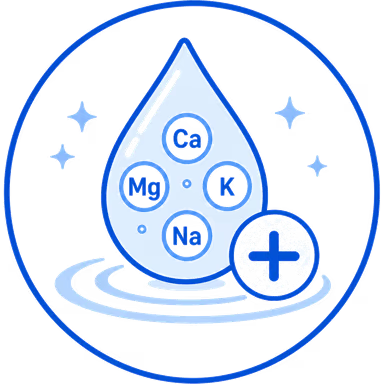
Polishes taste and adds minerals back for flavor